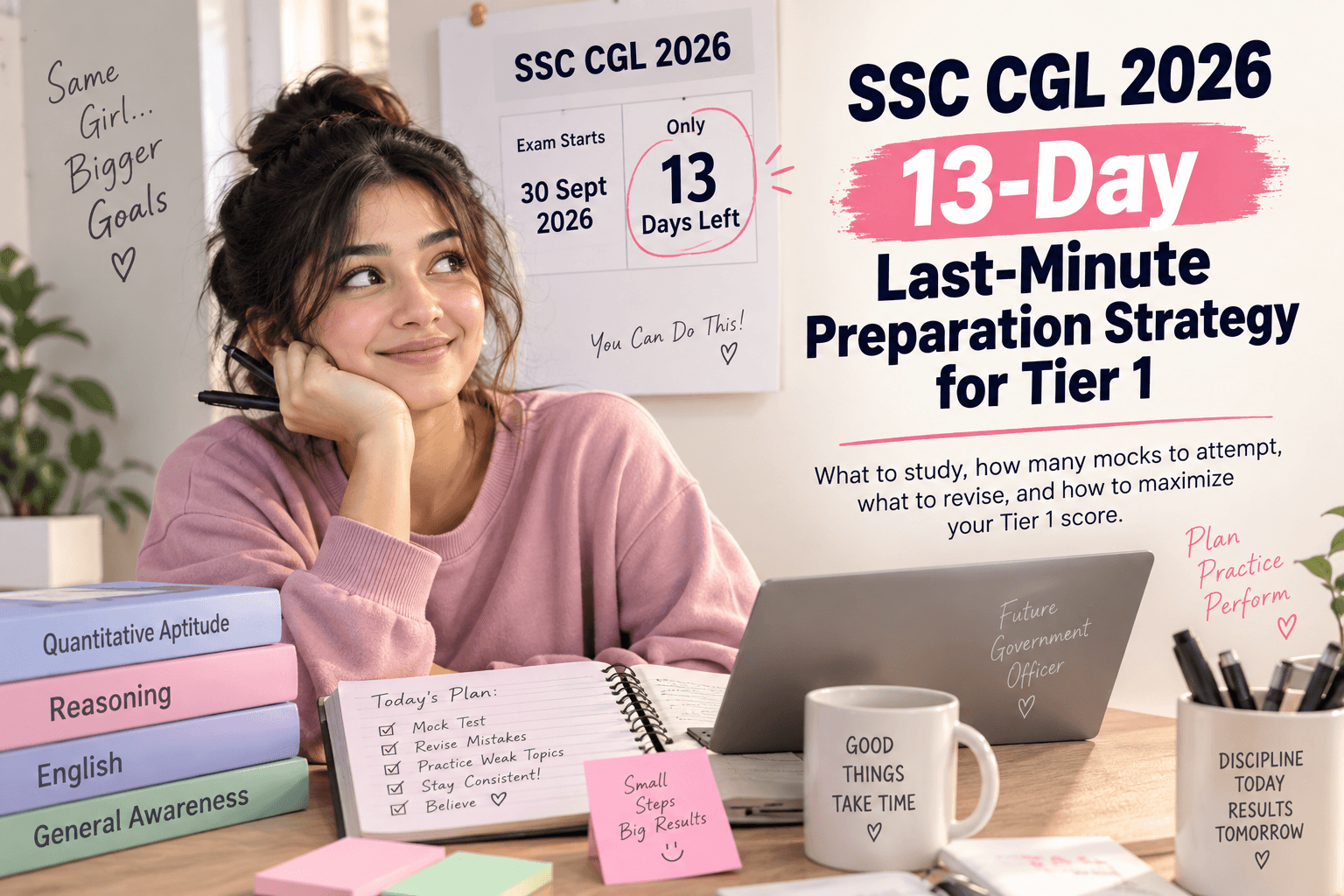
SSC has confirmed that CGL Tier-1 2026 runs from September 30 to October 30 — which means, as of today, you have roughly 13 days before the exam window opens. That's not enough time to learn a new topic from scratch, and treating it that way is the single biggest mistake candidates make in the final stretch. What moves your score in 13 days is different from what moves it in three months: less new content, more timed practice, and a lot more attention to why you're getting questions wrong. Here's a day-by-day plan for what's left.
SSC CGL Tier-1 2026: how much time do you actually have?
Tier-1 runs as a computer-based exam across multiple shifts between September 30 and October 30 — your own slot could fall anywhere in that window, so check your admit card the moment it's released rather than assuming you sit on day one. Either way, the practical planning horizon is the same: about 13 days from today until the window opens, and possibly a few more before your specific shift. Don't spend any of it trying to "finish the syllabus." At this stage, finishing means revising and testing what you already know, not adding new ground — the Tier-1 exam pattern (100 questions, four sections, +2/−0.5 marking) tells you exactly what's being scored, and every hour left is worth more spent inside that structure than outside it.
Your 13-day study plan
Compress rather than cram. Each block below builds on the one before it — skipping straight to mocks without the revision and topic-practice underneath them just repeats mistakes faster.
| Days | Focus | What to actually do |
|---|---|---|
| Day 1–3 | Diagnose + revise fundamentals | Take one sectional test per subject to find your weakest areas, then revise core formulas, grammar rules, and static GK you're shakiest on. No new topics. |
| Day 4–7 | Section-wise practice + PYQs | Drill each weak topic in isolation, then work through previous-year questions on it to see exactly how SSC actually tests it. |
| Day 8–10 | Full-length mocks | Switch to one full mock a day under real Tier-1 timing and marking — this is where speed and exam temperament get built, not before. |
| Day 11–12 | Error revision | Stop taking new mocks. Re-solve every question you got wrong across your mocks and PYQs, sorted by why you got it wrong. |
| Day 13 | Light revision + strategy | Skim formula sheets and current-affairs notes, plan your section order and time budget for exam day, and rest. No new content. |
How many mock tests should you attempt?
There's no single right number, but a workable rhythm for the final stretch is one full-length mock test a day starting around Day 8. Two rules matter more than the count itself:
- Spend nearly as much time reviewing a mock as taking it. A 60-minute mock deserves 40–50 minutes of review — otherwise you're repeating the same mistakes at a faster pace.
- Take mocks under real conditions. Full length, real timing, real negative marking. A mock solved untimed or with pauses tells you almost nothing about exam-day performance.
Track three numbers across your mocks: accuracy (improving or plateaued?), speed (average time per question, by section), and repeated mistakes — the same error showing up in mock three that showed up in mock one is a signal, not bad luck.
Haven't sat a full mock yet? That's the highest-leverage thing you can do today.
Subject-wise last-minute strategy
- Quantitative Aptitude — no new chapters. Revise formula sheets for topics you already know, and put practice time into previous-year questions rather than fresh problem sets — PYQs show exactly which shortcuts SSC rewards.
- General Intelligence & Reasoning — this is the section where volume in the final days still pays off. A mixed drill of series, coding-decoding, analogy, and non-verbal sets keeps pattern recognition sharp without needing new theory.
- English Comprehension — stop adding new vocabulary lists this late; you won't retain them under pressure. Drill grammar rules you already know until they're automatic, and use every mock's comprehension passage as timed reading practice.
- General Awareness — for static GK, revise your existing notes subject by subject rather than reading new material. For current affairs, skim the last 4–6 months rather than trying to catch up on a full year; SSC weights recent events more heavily.
The most important habit: analyse every mock, not just take it
After every mock, sort each wrong — and each slow-but-correct — answer into one of five buckets before you move on:
| Bucket | What it means, and the fix |
|---|---|
| Concept gap | You didn't know how to solve it. Fix: back to topic-wise practice on that specific concept. |
| Time pressure | You knew how, but ran out of time or rushed the last few questions. Fix: pacing, not content review. |
| Silly mistake | A calculation slip or misread question on something you actually know. Fix: slower, deliberate redoing of similar questions. |
| Guessing error | You guessed and got it wrong. Fix: review your skip/guess threshold given SSC's −0.5 penalty. |
| Correct but slow | You got it right, but it cost you disproportionate time. Fix: drill that question type for a faster method, not just more repetition. |
Five mocks reviewed this way teach you more than fifteen taken back-to-back with no review.
What not to do in the final 13 days
- Starting a completely new book or course this late.
- Watching hours of random exam-strategy videos instead of practicing.
- Skipping mocks because you "don't feel ready" — readiness only shows up once you start testing.
- Trying to memorize large amounts of new material, especially in General Awareness.
- Taking mocks without analysing them afterward.
The 13-day mock test challenge
Take a free mock test today. Review every wrong answer using the five buckets above. Spend tomorrow on your weakest topic in topic-wise practice or against real previous-year questions. Then take another mock. Repeat that loop for the next 13 days and you'll walk into Tier-1 having already made your mistakes somewhere that doesn't cost you a Group B or C posting.
Take Free Mock TestFrequently asked questions
How should I prepare for SSC CGL Tier-1 in the last 13 days?
Spend the first few days diagnosing weak areas and revising fundamentals, the middle days on section-wise practice and PYQs, then shift entirely to full-length mocks with thorough error review before tapering off in the final one to two days. Don't start new topics this late.
How many mock tests should I take before SSC CGL Tier-1 2026?
Roughly one full-length mock a day once you reach the mock-test phase (around Day 8), reviewed as thoroughly as it was taken. Fewer, carefully analysed mocks beat many unreviewed ones.
Should I start new topics this close to SSC CGL Tier-1?
No. With under two weeks left, new topics rarely get learned deeply enough to convert into exam marks. Time is better spent revising what you already know and fixing recurring mistakes from mocks and PYQs.
When is SSC CGL Tier-1 2026?
SSC has announced the Tier-1 exam window as September 30 to October 30, 2026, run across multiple computer-based shifts. Your individual exam date, shift, and centre will be confirmed on your admit card.
What's the best way to analyse a mock test?
Sort every wrong (and slow-but-correct) answer into a concept gap, a time-pressure error, a silly mistake, a guessing error, or a correct-but-slow answer — each needs a different fix, from revisiting a topic to adjusting your skip/guess threshold.


