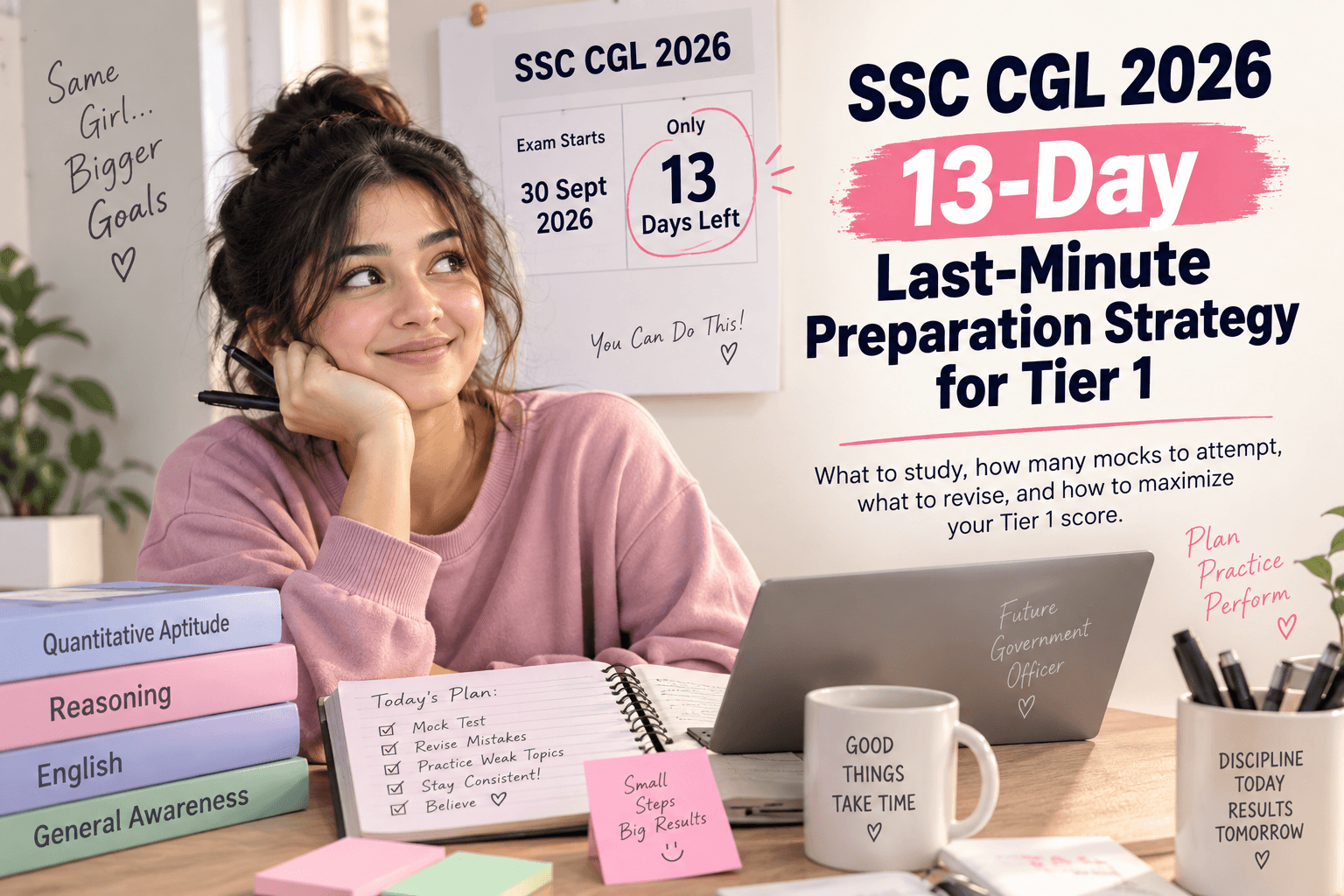
Most SSC CGL prep advice collapses into one instruction: solve more questions. That's necessary but not sufficient. The aspirants who convert preparation into a clearance don't just solve more — they solve in an order and a rhythm that matches how the exam is actually scored: shift-normalized Tier-I marks, negative marking, and a 60-minute clock that punishes hesitation almost as much as ignorance. A strategy is really just three decisions: what to learn first, how to practice it, and when to stop practicing and start testing.
What should an SSC CGL strategy actually optimize for?
Three things, in tension with each other: accuracy (negative marking means a wrong guess costs more than a skipped question), speed (well under a minute per question in Tier-I, once you account for reading time), and balance across sections (Tier-I is common to every applicant, so one weak section can drag down an otherwise strong attempt). A good strategy doesn't chase all three at once — it builds accuracy first, adds speed once accuracy holds, and only then worries about balancing weaker sections against stronger ones. See the full SSC CGL exam pattern if you haven't mapped out sections, marks, and timing yet.
Build your subject-wise plan around your weakest section, not your favorite one
It's tempting to spend more time on the section you're already good at — it feels productive because you solve questions correctly and quickly. But Tier-I scores all four sections equally, so an hour spent moving a weak section from 40% to 60% accuracy is worth more than an hour polishing a strong section from 85% to 90%. A workable split:
- Quantitative Aptitude — build the underlying concepts first, then layer on short methods and calculation speed. Formula recall should become automatic well before you start timing yourself.
- General Intelligence & Reasoning — mostly a pattern-recognition skill. Repetition across question types (series, coding-decoding, analogy, non-verbal sets) matters more here than memorizing rules.
- English Comprehension — grammar rules and vocabulary are learnable in bulk early on; reading comprehension speed is the part that only improves with sustained daily practice.
- General Awareness — the hardest section to "practice" in the traditional sense. Static GK rewards structured revision (one subject area at a time); current affairs rewards a daily reading habit you can't compress into a last-minute cram.
A three-phase timeline that works backward from your exam date
Rather than a fixed "6-month plan," it's more useful to think in three phases and split your remaining time across them — the ratios hold whether you have four months left or four weeks.
| Phase | Roughly how long | Focus |
|---|---|---|
| Foundation | ~40% of your remaining time | Cover the full syllabus, topic by topic, with concepts and short methods — not speed yet. |
| Topic-wise practice | ~35% of your remaining time | Drill each topic in isolation until section accuracy is consistently above your target cut-off. |
| Mocks & revision | ~25% of your remaining time | Full-length mocks under real timing and marking, plus error-log review — this is where speed and temperament are built. |
The most common timing mistake is spending too long in Foundation out of a desire to "feel ready" before testing — real readiness only shows up once you start timing yourself in Phase 2 and 3.
Previous-year questions are the highest-leverage resource you have
SSC repeats question patterns, difficulty distributions, and even specific concepts more than most aspirants expect. Working through previous-year questions does two things a generic question bank can't: it shows you exactly how a topic gets tested (not just what the topic is), and it calibrates your sense of difficulty against the real exam instead of against practice material that may be easier or harder than what you'll actually face. Treat PYQs as diagnostic first, drilling second — a topic where you consistently miss PYQ-style questions is telling you where Foundation-phase work is still incomplete.
Why mock tests matter more than they get credit for
Solving questions untimed and solving them inside a 60-minute, negatively-marked, four-section paper are different skills — the second one is what actually gets tested. Full-length mock tests under the real time limit and +2/−0.5 marking build the exam-day temperament (when to skip, when to guess, how to pace across sections) that no amount of untimed practice teaches.
Three mistakes that quietly cap most aspirants' scores
- Postponing the weak section. It's easier to keep practicing what you're already good at, but a weak section left untouched until the final weeks rarely improves enough in time — start it in Phase 1, not Phase 3.
- Practicing without a timer. Untimed accuracy is necessary but tells you nothing about whether you can hold that accuracy under exam-pace pressure. Introduce timing as soon as Foundation-level accuracy is reasonable, not only in the final mock phase.
- Solving mocks without reviewing them. A mock test's value is almost entirely in the post-mortem — taking ten mocks without analyzing errors teaches you far less than taking four and reviewing each one thoroughly.
How to turn a mock test into actual improvement
After every mock, sort your mistakes into three buckets: concept gaps (you didn't know how to solve it), calculation or silent errors (you knew how, but slipped), and time-pressure errors (you knew how, but ran out of time or rushed). Each bucket has a different fix — concept gaps send you back to topic-wise practice, calculation errors need slower, deliberate redoing of similar questions, and time-pressure errors need better in-exam pacing, not more content review. Track section-wise accuracy across mocks over time — a rising trend matters more than any single mock's score.
Frequently asked questions
What is the best SSC CGL preparation strategy for beginners?
Start with a Foundation phase covering the full syllabus concept by concept, move into timed topic-wise practice once accuracy is reasonable, then add full-length mocks. Build your weakest section early rather than leaving it for later.
How many hours a day should I study for SSC CGL?
Consistency matters more than any specific hour count — a sustainable daily routine across all four sections, sustained for months, outperforms sporadic long sessions. Allocate more time to your weakest section, not your strongest.
How important are previous-year questions for SSC CGL?
Very. SSC repeats patterns and difficulty distributions more than expected, so PYQs are both a diagnostic tool (showing where your preparation is weakest) and realistic practice material.
How many mock tests should I take before SSC CGL Tier-I?
Fewer, thoroughly reviewed mocks generally beat many unreviewed ones. What matters is analyzing each mock's errors — concept gaps, calculation slips, and time-pressure mistakes each need a different fix.
Should I focus on my strong sections or weak sections?
Weak sections first. Since all four Tier-I sections carry equal marks, improving a weak section from a low base typically raises your total score more than further polishing an already-strong section.